The SOSTAC Model: How We Build a Marketing Plan for Your Business, Step by Step
Most marketing plans fail because they start with channels before understanding the situation. SOSTAC puts your thinking in six clear stages, from "where are we now?" to "are we hitting the goal?".
Key takeaway: SOSTAC is a six-stage marketing planning framework: Situation, Objectives, Strategy, Tactics, Action and Control. Its value is that it stops you from launching ads before you know where you stand, what you want and how you will measure success.
Many businesses start marketing at the end of the chain: an Instagram account, a Snapchat campaign, daily posts — and three months later they ask why sales haven't grown. The problem is rarely the channel; it is the lack of a plan that ties every riyal to a clear goal. The SOSTAC model is how we build that plan at Masar Atamayoz. It was created by marketing expert PR Smith and is widely used because it is simple, logical and works for small and large businesses alike.
The name is an acronym of its six stages. Each stage answers one question, and we don't move to the next until the answer is clear and written down.
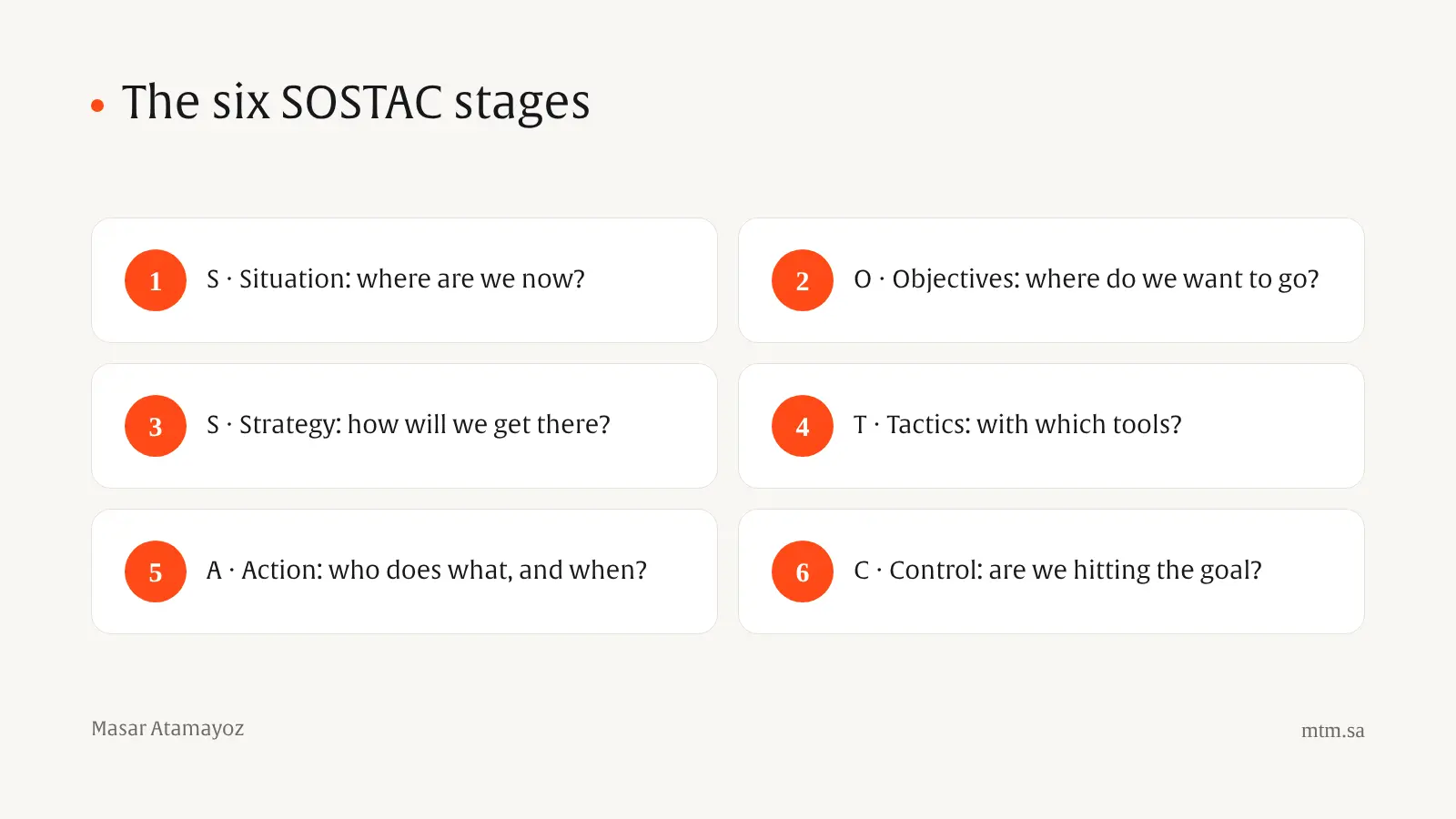
S — Situation: where are you now?
Before any decision, we need an honest picture of today. In this stage we gather and analyse:
- Current channel performance: website traffic and its sources, conversion rate, past campaign results and cost per lead.
- The customer: who actually buys? What problem does your product solve? Which words do they search for? What objection delays their decision?
- Competitors: their offers, prices, ad messages, and where they appear in search and Maps.
- Strengths and weaknesses: what truly sets you apart, and what stops customers buying from you today (a slow page, few reviews, an unclear offer)?
The most important outcome of this stage is finding the real problem. Sometimes it is the landing page, not the ad — or the sales follow-up, not marketing at all.
O — Objectives: where do you want to go?
A good objective is a number with a deadline, not a general sentence. "We want more awareness" can't be measured; "60 qualified quote requests a month within 90 days at no more than SAR 250 per lead" can.
We tie every objective to KPIs we track with you: cost per lead, conversion rate, share of qualified leads and return on ad spend. And we work out from the start how much you can pay per customer without losing money, so campaigns are never judged on likes and views.
S — Strategy: how will you get there?
Strategy is the big decisions that steer everything after it:
- Target audience: which segment do we start with, and which do we postpone?
- Positioning and message: why should a customer choose you over a competitor, and what sentence should they remember?
- Channels: does demand for your service come from search (Google Ads and Google Maps) or from discovery (Snapchat, TikTok and Instagram)?
- Customer journey: how do people move from first hearing about you to comparing, buying, buying again and recommending you?
A good strategy says "no" to a lot. One strong acquisition channel plus one supporting trust channel beats five weak channels.
T — Tactics: with which tools?
Here the strategy becomes specific, practical tools: the monthly content plan, campaign types and platforms, offers, landing pages, website improvements, SEO and the budget split across channels. For example: a Google search campaign on high-intent keywords, short video ads for retargeting, and a free guide that collects leads.
Every tactic must serve the strategy and be measured against a KPI from stage two. A tactic you can't measure is a budget you can't defend.
A — Action: who does what, and when?
The best plan without disciplined execution stays on paper. Here we write a clear schedule: tasks, the owner of each task, deadlines, and what the team needs from you (photos, prices, approvals). At Masar Atamayoz, a dedicated account manager follows this schedule weekly, so campaigns don't stall waiting for an approval or a page that hasn't gone live.
C — Control: are you hitting the goal?
We set up tracking before launch, not after: Google Analytics, conversion tags on every platform, and tracking for lead forms and WhatsApp clicks. We review the numbers weekly and send a monthly report showing where each riyal went and what it achieved.
Control isn't just a report; it is decisions: pause the ad that doesn't bring qualified leads, double what works, test a new message or page. The results then feed the situation analysis of the next cycle, so the plan becomes a loop that keeps improving.
A practical example: a maintenance company in Riyadh
- Situation: 70% of requests come by phone, the website is slow on mobile, and competitors appear above it in Maps.
- Objective: 120 requests a month within 90 days at under SAR 60 per request.
- Strategy: focus on north and east Riyadh, the message "a technician at your door within two hours", search as the main channel.
- Tactics: optimise the Google Business profile, a search campaign on urgent keywords, a fast landing page with call and WhatsApp buttons.
- Action: two weeks for the page and tracking, then launch with a weekly review.
- Control: a monthly report on cost per request and share of completed jobs, adjusting keywords and districts based on results.
Common mistakes when applying SOSTAC
- Jumping to tactics: starting the content plan before analysing the situation and setting the objective.
- Unmeasurable objectives: "we want more reach" instead of a number and a date.
- Long analysis, no decision: analysis is a means to decide, not a report to file away.
- Skipping control: a plan written once and not reviewed until year end.
SOSTAC FAQ
Is SOSTAC suitable for small businesses?
Yes. The model is flexible; for a small business the whole plan may be two pages, but the same six questions protect it from spending on channels that don't fit. See also our marketing plan for small businesses on a realistic budget.
How long does a SOSTAC plan take to prepare?
Situation analysis, objectives and strategy usually take one to three weeks depending on the size of the business and the data available; then the action and control cycle begins.
How often should the plan be reviewed?
We track the numbers weekly, review tactics monthly, and revisit strategy and objectives every quarter or whenever the market changes significantly.
What is the difference between SOSTAC and a SWOT analysis?
SWOT is a tool used inside one stage — the situation analysis — while SOSTAC is a complete framework covering the plan from analysis to action and control.
Next step
We build your marketing plan with SOSTAC: a session to understand where you are and what you want, then a clear plan with numbers, channels and budget.
Read next
Related articles
A Digital Marketing Plan for Small Businesses in Saudi Arabia: Where to Start on a Realistic Budget
On a limited budget, the problem is usually running every channel at once. Start with one measurable goal, one channel…
How to Choose a Digital Marketing Agency in Saudi Arabia: 12 Questions Before You Sign
Choosing an agency doesn't start with "how many posts?" but with goals, measurement and data ownership. These 12 questions make…
Social Media Management for Businesses in Saudi Arabia: A Practical Guide from Plan to Results
Social media is not random posting. A practical guide to managing your company's accounts: platforms, content, ads, replies and the…